Ron's View Of The Universe
Views
Thumbnail Views
Comments
Catelog/ID
As Know As
Name/Discription
Constillation
Size
Magnatude
Distance
Date Taken
Telescope
Exposure
Pic Notes
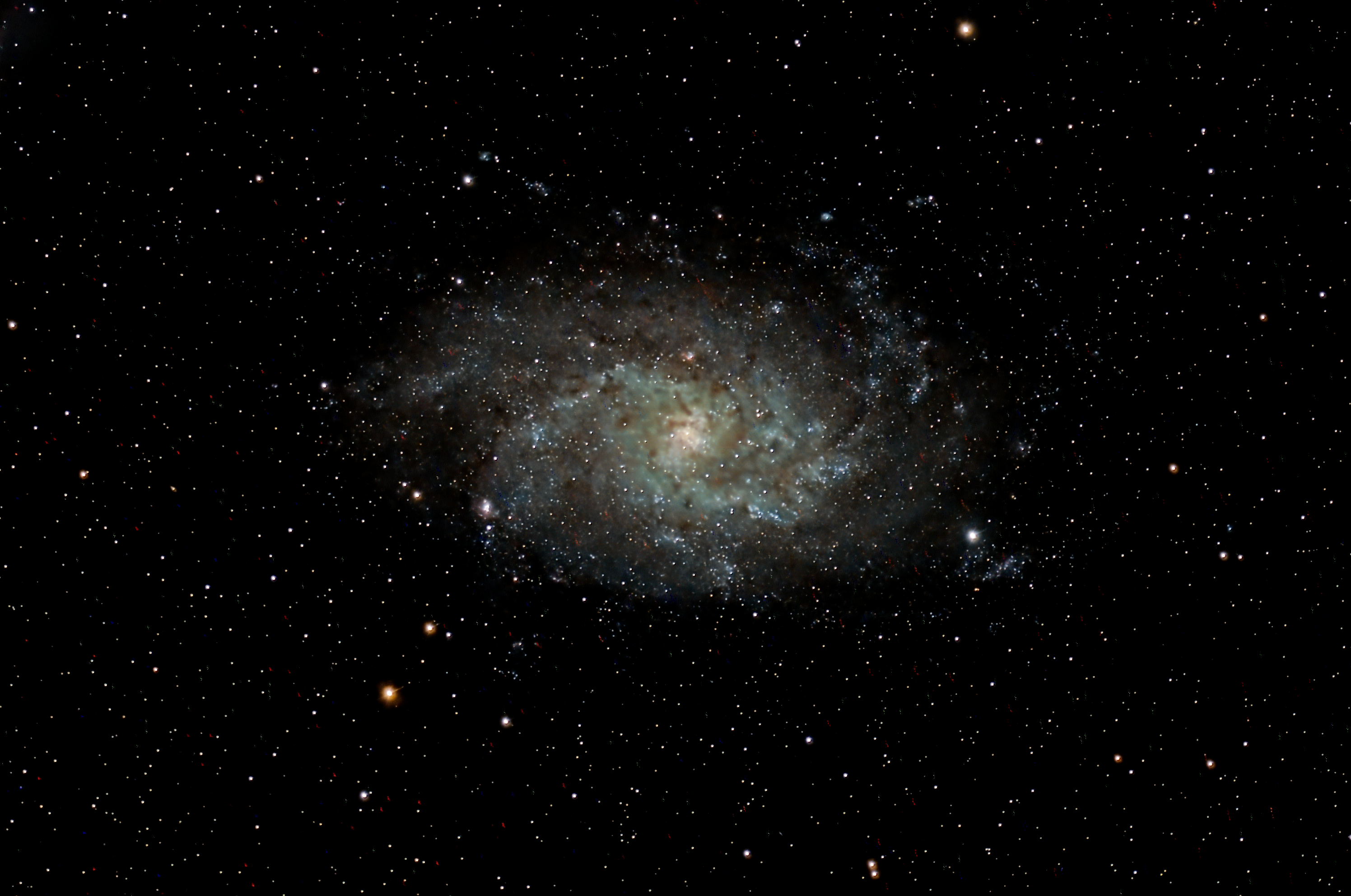
The Pinwheel Galaxy (also known as Messier 101, M101 or NGC 5457) is a face-on, counterclockwise Intermediate spiral galaxy located 21 million light-years from Earth in the constellation Ursa Major. It was discovered by Pierre Méchain in 1781 and was communicated that year to Charles Messier, who verified its position for inclusion in the Messier Catalogue as one of its final entries. M101 is a large galaxy, with a diameter of 252,000 light-years. By comparison, the Milky Way has a diameter of 87,400 light-years. It has around a trillion stars. It has a disk mass on the order of 100 billion solar masses, along with a small central bulge of about 3 billion solar masses. Its characteristics can be compared to those of Andromeda Galaxy. M101 has a high population of H II regions, many of which are very large and bright. H II regions usually accompany the enormous clouds of high density molecular hydrogen gas contracting under their own gravitational force where stars form. H II regions are ionized by large numbers of extremely bright and hot young stars; those in M101 are capable of creating hot superbubbles. In a 1990 study, 1,264 H II regions were cataloged in the galaxy. Three are prominent enough to receive New General Catalogue numbers—NGC 5461, NGC 5462, and NGC 5471. M101 is asymmetrical due to the tidal forces from interactions with its companion galaxies. These gravitational interactions compress interstellar hydrogen gas, which then triggers strong star formation activity in M101's spiral arms that can be detected in ultraviolet images. In 2001, the X-ray source P98, located in M101, was identified as an ultra-luminous X-ray source—a source more powerful than any single star but less powerful than a whole galaxy—using the Chandra X-ray Observatory. It received the designation M101 ULX-1. In 2005, Hubble and XMM-Newton observations showed the presence of an optical counterpart, strongly indicating that M101 ULX-1 is an X-ray binary. Further observations showed that the system deviated from expected models—the black hole is just 20 to 30 solar masses, and consumes material (including captured stellar wind) at a higher rate than theory suggests. It is estimated that M101 has about 150 globular clusters, the same as the number of the Milky Way's globular clusters. On February 28, 2006, NASA and the European Space Agency released a very detailed image of the Pinwheel Galaxy, which was the largest and most detailed image of a galaxy by Hubble Space Telescope at the time. The image was composed of 51 individual exposures, plus some extra ground-based photos. This is the second attempt in imaging M 101, the first image taken 06/17/25 with Origin for 30m.
Return To Listing