Ron's View Of The Universe
Views
Thumbnail Views
Comments
Catelog/ID
As Know As
Name/Discription
Constillation
Size
Magnatude
Distance
Date Taken
Telescope
Exposure
Pic Notes
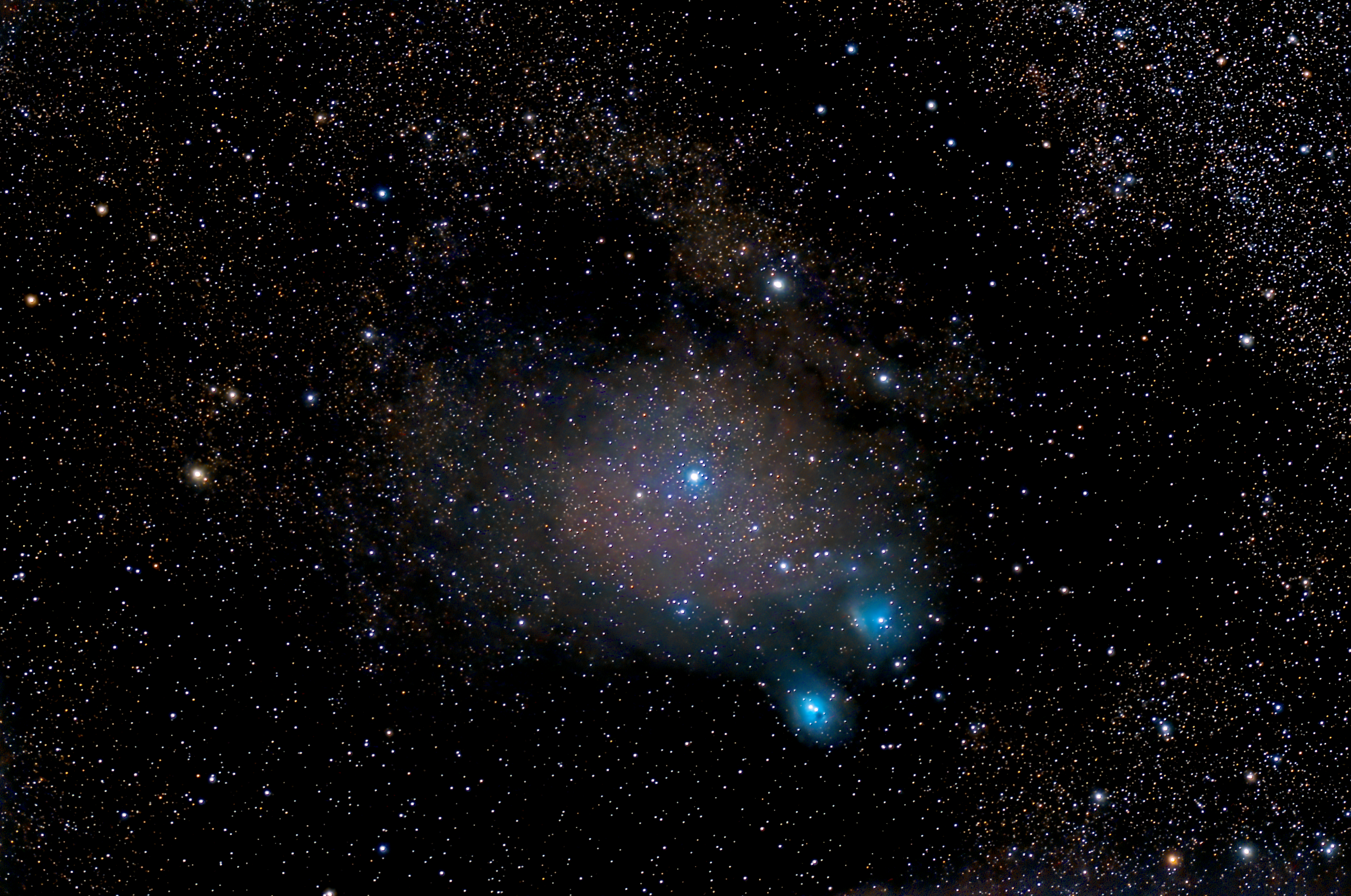
IC 1284 is an emission nebula located in the constellation Sagittarius. This deep-sky object lies very close to the Small Sagittarius Star Cloud (M24) along the plane of the Milky Way. In the northern hemisphere, the best time to see and photograph IC 1284 is in the summer from the months of June-September. Although this nebula is bright, it is smaller than some of the more well-known emission nebulae in the area. On 14 July 1830 John Herschel discovered a «double star, involved in a pretty bright large nebula 50".» He observed it again in the two following nights and sketched it. He cataloged the object as h 2002 and later as GC 4395, which became to NGC 6595 in Dreyer's «New General Catalogue». Lewis Swift independently found this reflection nebula on 12 July 1885. But his position for Sw II-62 is 45 seconds of RA too far west, hence it was listed by Dreyer as NGC 6590 unknowingly it was a double entry. Edward Emerson Barnard mentioned this object again and it received a third designation: IC 4700. By order of discovery, NGC 6595 should take precedence. [313, 364, 466] Truman Safford discovered NGC 6589 on 28 August 1867. Lewis Swift independently discovered this reflection nebula on 12 July 1885 and recorded «Another D* in centre of an eF, pL nebulosity; np of 2 [with NGC 6590]. Except for the inequality of the stars and the excessive faintness of the nebula, it would resemble the preceding [Sw II-62 = NGC 6590].» As Safford's discovery list was not published until 1887 when Dreyer had already compiled the NGC table, Swift was credited with the discovery. In 1905 Edward Emerson Barnard reported: «Stars 9.5 mag in nebulosity, extended, south preceding, north following» which was added as IC 4690 in Dreyer's «Second Index Catalogue» [315, 364] IC 1284 was discovered by Barnard on a photographic plate taken with the 6" Willard lens on 31 May 1892. He noted: «An unknown nebulous star [BD -19°4953]. It is shown on the photograph to be nearly symmetrically surrounded with a faint diffused nebulosity about 15' in diameter. Perhaps this nebulosity is a little denser and more extensive following. Visually with the 12 inch, I cannot be certain of seeing the nebulosity on account of the brightness of the central star.» On another photographic plate taken with the 6" Willard lens in June 1892 he discovered IC 1283 and commented that BD -19° 4948 is nebulous and «the nebulosity is very small and principally noticeable on the southern side of the [9.3 magnitude] star.» [364] In 1946 the Swedish astronomer Sven Cederblad published a study of bright diffuse galactic nebulae where he listed this nebula as Cederblad 157, consisting of four parts (A through D). [130] The American astronomer Stewart Sharpless studied the photo plates of the «Palomar Observatory Sky Survey» made with the 48 inch Schmidt telescope and published in 1959 «A Catalogue of H II Regions». Nebula Sh 2-37 with a diameter of 20 arcminutes is identified with this region, containing stars HD 167722, HD 167815, HD 313098, which are within IC 1284. [270] Physical Properties IC 1284 is a star-forming region composed primarily of hydrogen. Its red glow comes from electrons within the hydrogen atoms. They are excited by the radiation from young stars, but lose energy afterwards and emit a specific colour or wavelength of light. NGC 6589 and NGC 6590 are reflection nebula, dust that scatters shorter, bluer wavelengths of light from nearby stars.
Return To Listing