Ron's View Of The Universe
Views
Thumbnail Views
Comments
Catelog/ID
As Know As
Name/Discription
Constillation
Size
Magnatude
Distance
Date Taken
Telescope
Exposure
Pic Notes
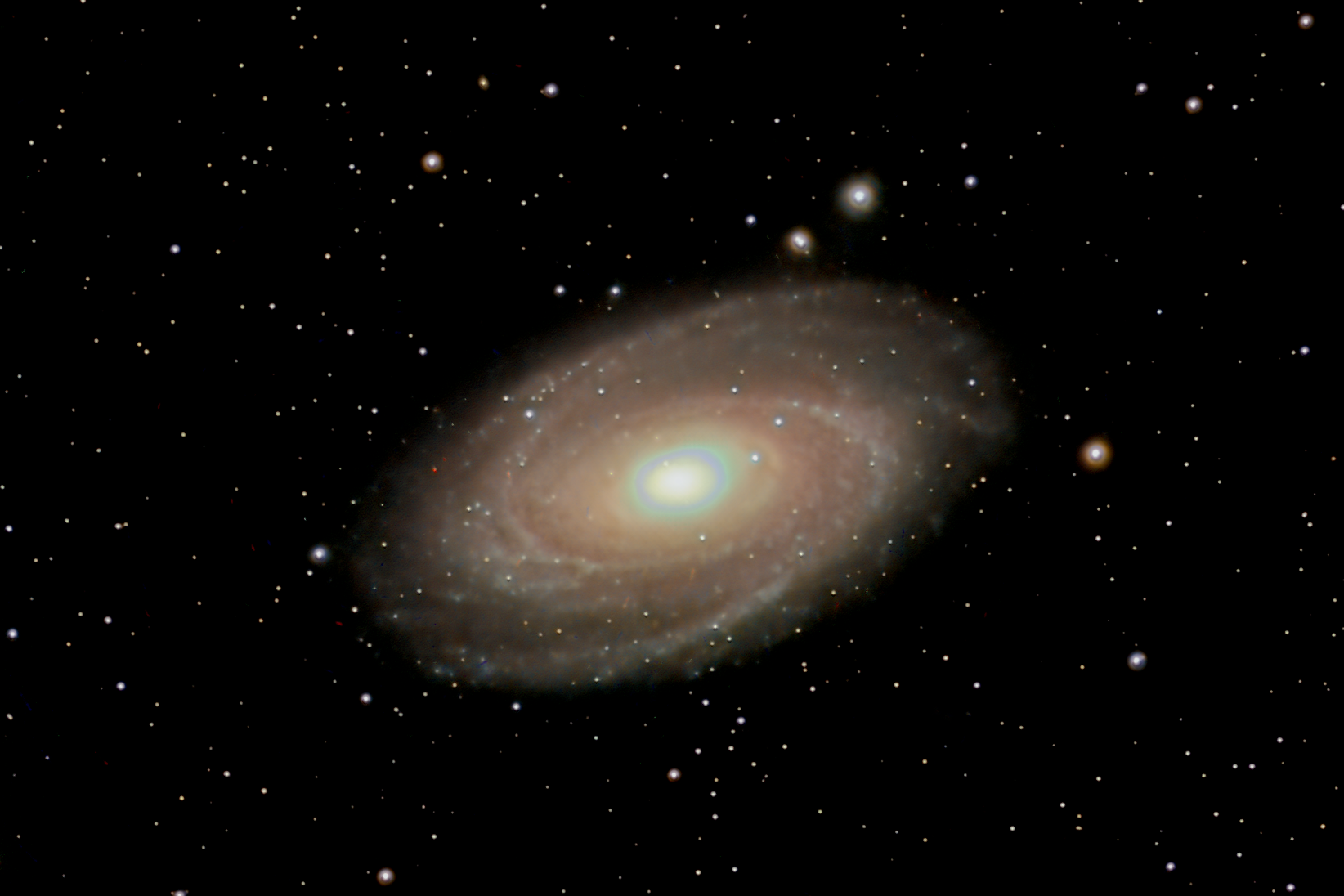
Messier 81 (also known as NGC 3031 or Bode's Galaxy) is a grand design spiral galaxy about 12 million light-years away in the constellation Ursa Major. It has a D25 isophotal diameter of 29.44 kiloparsecs (96,000 light-years). Because of its relative proximity to the Milky Way galaxy, large size, and active galactic nucleus (which harbors a 70 million M? supermassive black hole), Messier 81 has been studied extensively by professional astronomers. The galaxy's large size and relatively high brightness also makes it a popular target for amateur astronomers. In late February 2022, astronomers reported that M81 may be the source of FRB 20200120E, a repeating fast radio burst. The galaxy is to be found approximately 10° northwest of Alpha Ursae Majoris (Dubhe) along with several other galaxies in the Messier 81 Group. Its apparent magnitude due to its distance means it requires a good night sky and only rises very briefly and extremely low at its southernmost limit from Earth's surface, about the 20th parallel south. Messier 81 and Messier 82 are considered ideal for viewing using binoculars and small telescopes. The two objects are generally not observable to the unaided eye, although highly experienced amateur astronomers may be able to see Messier 81 under exceptional observing conditions with a very dark sky. Telescopes with apertures of 8 inches (20 cm) or larger are needed to distinguish structures in the galaxy. An infrared image of Messier 81 taken by the Spitzer Space Telescope. The blue colors represent stellar emission observed at 3.6 µm. The green colors represent 8 µm emission originating primarily from polycyclic aromatic hydrocarbons in the interstellar medium. The red colors represent 24 µm emission originating from heated dust in the interstellar medium. The galaxy is best observed during April.
Return To Listing