Ron's View Of The Universe
Views
Thumbnail Views
Comments
Catelog/ID
As Know As
Name/Discription
Constillation
Size
Magnatude
Distance
Date Taken
Telescope
Exposure
Pic Notes
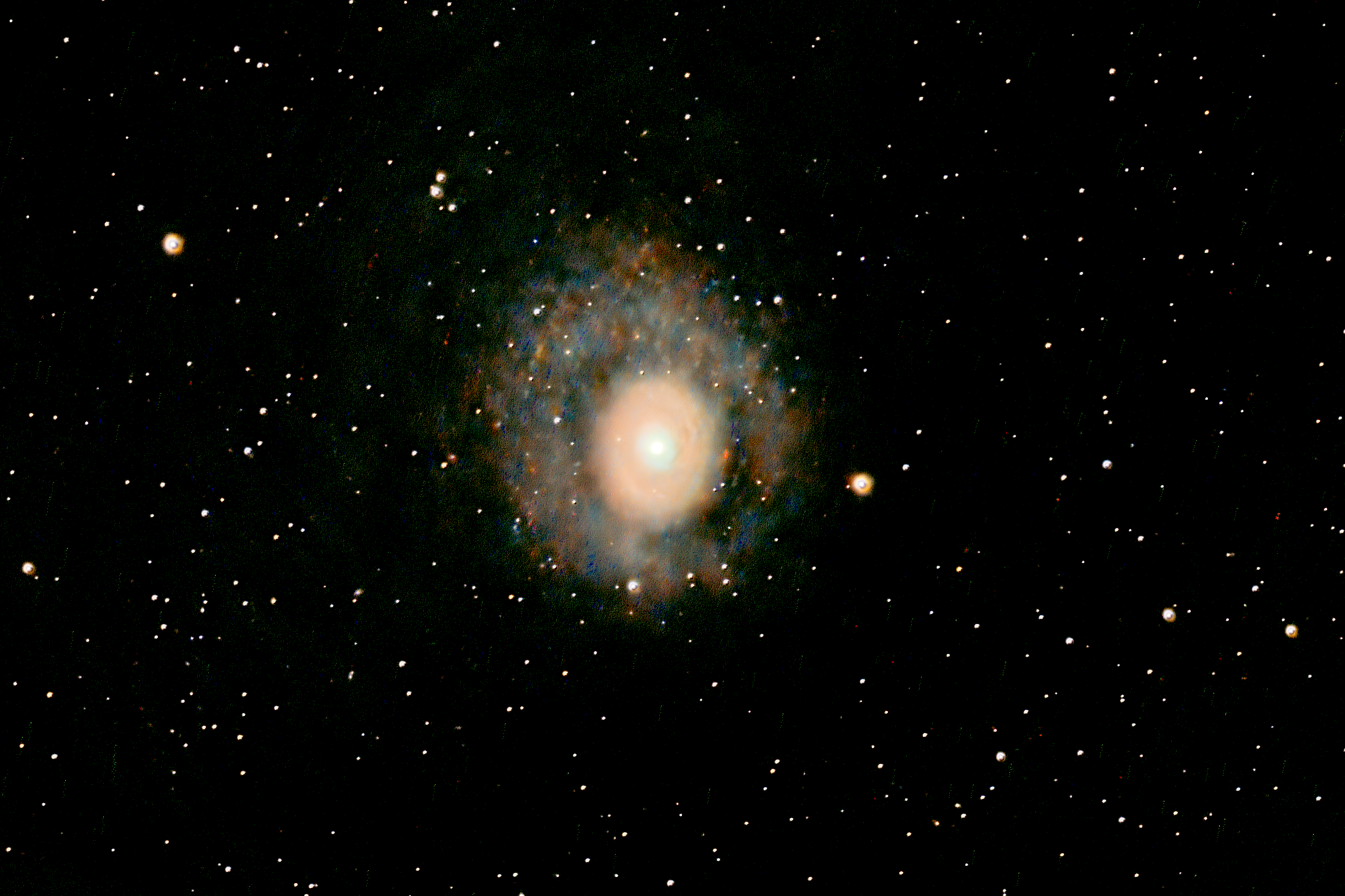
Messier 94 (also known as NGC 4736, Cat's Eye Galaxy, Crocodile Eye Galaxy, or Croc's Eye Galaxy) is a spiral galaxy in the mid-northern constellation Canes Venatici. It was discovered by Pierre Méchain in 1781, and catalogued by Charles Messier two days later. Although some references describe M94 as a barred spiral galaxy, the "bar" structure appears to be more oval-shaped. The galaxy has two ring structures. M94 is classified as having a low ionization nuclear emission region (LINER) nucleus. LINERs in general are characterized by optical spectra that reveal that ionized gas is present but the gas is only weakly ionized (i.e. the atoms are missing relatively few electrons). M94 hosts a supermassive black hole (SMBH) with mass of 1.60 ? 107 M? as measured using stellar kinematics derived from James Webb Space Telescope (JWST) data. This result is consistent with the current MBH-s and - MBH-M?, gal relations M94 has an inner ring with a diameter of 70 arcseconds (given its distance, about 5,400 light-years (1,700 pc)) and an outer ring with a diameter of 600? (about 45,000 light-years (14,000 pc)). These rings appear to form at resonance points in the disk of the galaxy. The inner ring is the site of strong star formation activity and is sometimes referred to as a starburst ring. This star formation is fueled by gas driven dynamically into the ring by the inner oval-shaped bar-like structure.
Return To Listing